Ranger Minerals Program
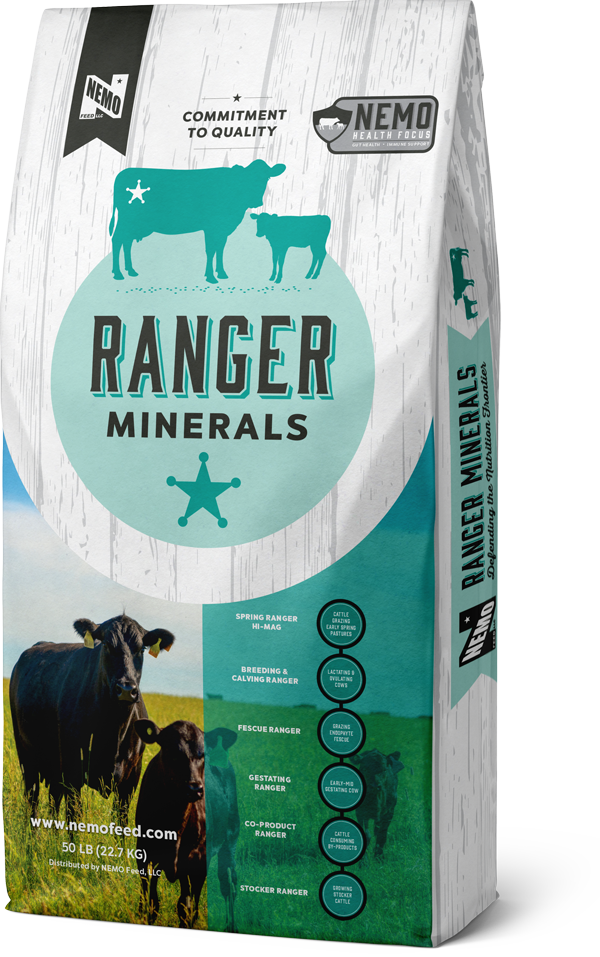
The Ranger Minerals Program is a research-driven mineral supplementation system designed to support every stage of beef cattle production—from gestation to finishing. Backed by university studies and field-proven results, Ranger Minerals delivers highly digestible, precision-formulated blends to enhance immunity, reproduction, and overall performance. With specialized products tailored for spring pastures, breeding, gestation, stocker cattle, and by-product diets, the program ensures your herd gets exactly what it needs, when it needs it—boosting productivity while controlling costs. Available with optional medications and fly control, Ranger Minerals is your trusted partner in defending the nutrition frontier.

Precision Nutrition
Customized formulations based on university research and real-world forage analysis.

Superior Absorption
Fine-ground minerals and chelated trace elements for maximum bioavailability

Better Herd Health
Boosts immunity, reproduction, and overall vitality at every stage.
Ranger Minerals Defense
Features & Benefits
- Highest quality chelated trace minerals
- Stabilized vitamins
- Tested and proven formulas
- Boosts immunity
- Maximum absorption
Through field research, university research, a large database of grass and feed samples, and accounting for extreme conditions; a precise level of supplementation can be calculated for each stage of beef production to save you money.
Phosphorus (P) Levels of Grass Compared to Lactating/Gestating Cows & Calf Requirements

*Phosphorus of the grass plus a 6% P mineral fed at 4 oz/day from May to July and a 3% P mineral fed at 4 oz/day from August to October. Dr. Jim Russell and Mathew Haan; Iowa State University.
Researchers at Iowa State University reported P content of grass from May through October met requirements of lactating cows in many cases, and minimal supplemental P is needed. Calves gaining 2.0 pounds per day did not need any supplemental P (see graph above). They also noted that cows selected forages 25% higher in P than manually clipped grass samples (see chart below).
Comparison of Phosphorus Concentrations of Available & Selected Forage in Rotationally Stocked Cool Season Grass Pastures
phosphorus %
| Available Forage** | Selected Forage | |
|---|---|---|
| May | 0.47 | 0.62 |
| July | 0.39 | 0.49 |
| September | 0.38 | 0.65 |
**Available Forage = hand clipped to approximately 2 cm above ground level, Selected Forage = collected from a ruminally cannulated steer following a two hour grazing period.
Mineral is more expensive, so higher digestibility means you get return for your money. The swine and poultry industries fine grind corn to improve its digestibility. The beef industry doesn’t use fine ground corn because it is digested too rapidly and causes digestive upsets. It only makes sense to feed a mineral that is a finer particle and not coarse rocks. The graph below shows a coarse mineral of a major competitor compared with our finer ground mineral with added oil. The finer ground mineral raised the pH of the acid much faster and higher than the coarse mineral resulting in improved digestibility.
PH of an Acid & Mineral Solution Over Time to Compare Digestibility Ofminerals With Different Particle Sizes

Minerals can bind with other minerals or compete for absorption causing deficiencies. For example, Zn and Cu compete for the same absorption site therefore they should be kept in a proper ratio. Zn and Cu should be increased or a protected form should be used when Mo, Fe, or S levels are high.
Zinc
Required: Growth, conception, spermatogenesis, tissue synthesis, wound healing, vitamin A metabolism, immunity, and hemoglobin & enzyme production
Deficiency: Poor feed, efficiency and intake
Iron
Required: Growth, immunity, and hemoglobin oxygen transport
Deficiency: High mortality in severe deficiency
Manganese
Required: Growth, rumen cellulytic bacteria, reproduction (conception, estrus, ovulation), protein synthesis, enzyme systems, immunity, and hormonal systems
Deficiency: Subject to interference by inorganic minerals
Copper
Required: Growth, ovulation, spermatogenesis, pigmentation of hair/skin, immunity, and enzyme/ collagen synthesis
Deficiency: Subject to interference by inorganic minerals
Iodine
Required: Metabolic regulation
Deficiency: Component of thyroid hormones (goiter in deficiency)
Cobalt
Required: Growth and vitamin B12 synthesis by rumen bugs
Deficiency: Feed intake depression and wasting disease
Selenium
Required: Growth and immunity
Deficiency: Retained placentas, White Muscle Disease and Mulberry Heart Disease

Mineral Interactions

| P | Phosphorus | Cu | Copper |
| Cr | Chromium | Mn | Manganese |
| Co | Cobalt | K | Potassium |
| Pb | Lead | Mo | Molybdenum |
| Fe | Iron | I | Iodine |
| Se | Selenium | Mg | Magnesium |
| Na | Sodium | Zn | Zinc |
| Ca | Calcium | Si | Silica |
| Ag | Silver | Ar | Arsenic |
| Cd | Cadmium | F | Florine |
| Hg | Mercury | S | Sulfur |
| Ai | Aluminum |
Our Products


Feed That Works As Hard As You Do
Give your animals the nutrition they deserve. Find a dealer near you or schedule a consultation to ensure your animals get the nutrition they need for optimal health and performance.